Section 04 · judge
Confidence is not a feeling.
Every assumption earns its way up an evidence scale. The rating describes the strength of the evidence, not the team's optimism. If we only have what people said, the highest rating is Indicated.
The levels of confidence
How strong is our evidence?
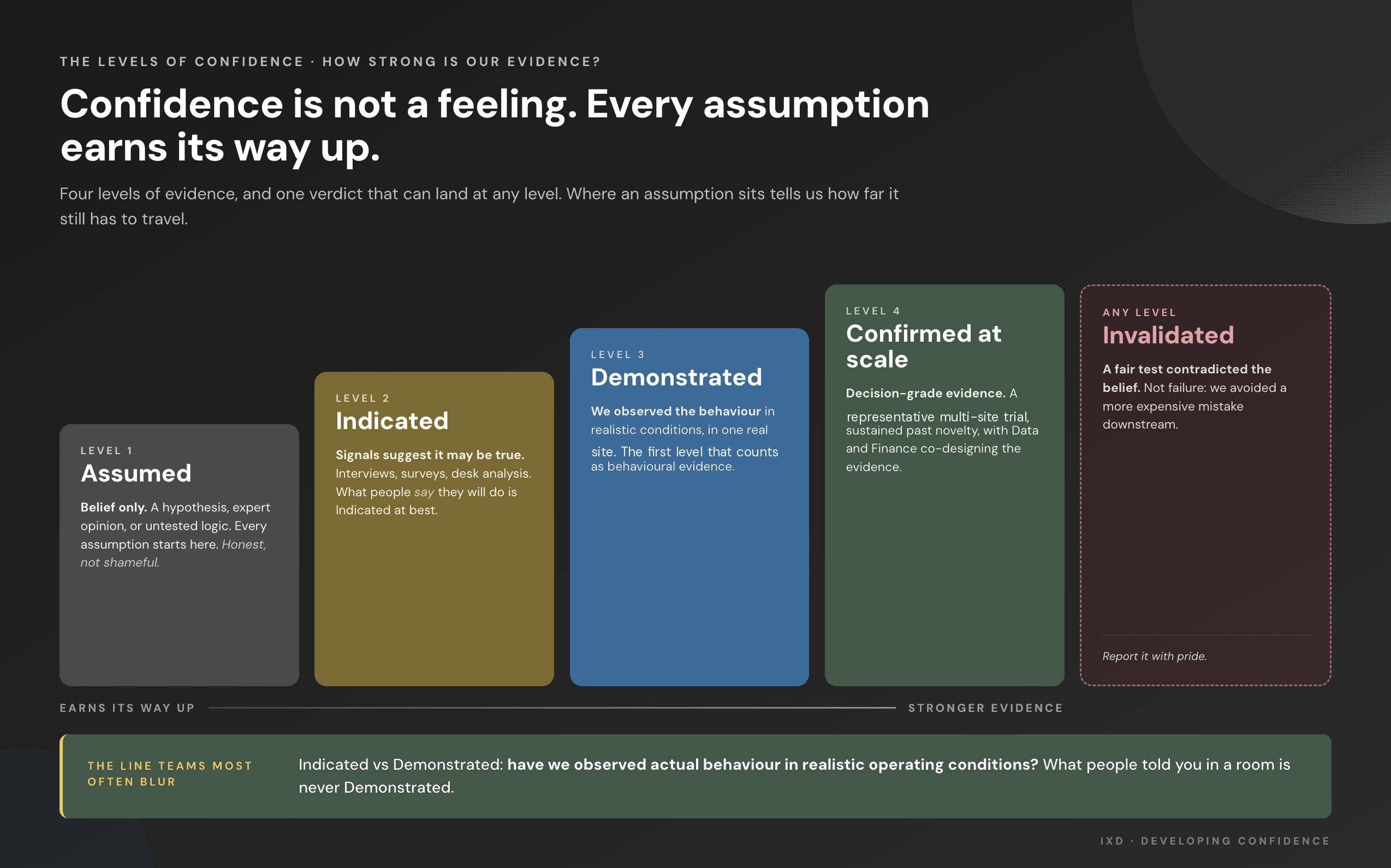
Assumed
Belief only. A hypothesis, expert opinion, or untested logic. Every assumption starts here. Honest, not shameful.
Indicated
Signals suggest it may be true. Interviews, surveys, desk analysis, analogous examples. What people say they would do is Indicated at best.
Demonstrated
We observed the behaviour in realistic operating conditions, in one real site. The first level that counts as behavioural evidence. Plausible becomes "we saw it."
Confirmed at scale
Decision-grade evidence. A representative multi-site trial, sustained past novelty, with Data and Finance co-designing the evidence. Suitable for scale or investment decisions.
Invalidated off-ramp at any level
A fair test contradicted the belief. Not failure: a more expensive mistake downstream was avoided. Report it with pride.
The line teams most often blur
Indicated versus Demonstrated. Have we observed actual behaviour in realistic operating conditions? What people told you in a room is never Demonstrated.
The trigger question
Have we observed actual behaviour in realistic operating conditions?
If no
The highest rating available is Indicated: signals only, or what people said. No evidence yet keeps it Assumed.
If yes
Demonstrated for one real site. Confirmed at scale for a representative trial sustained past novelty.
Prioritise the riskiest
Plot each assumption on a 2x2 to find the critical ones.
High risk if wrong, currently only Assumed. These are the critical assumptions. They have the greatest potential to change the direction of the work.
Critical assumptions
Could materially change the problem, solution, investment, operating model, or test design.
Monitor / strengthen for scale
Evidence exists, but broader testing may be needed before commitment.
Park or test lightly
Test only if quick, cheap, or needed for an upcoming decision.
Use as supporting evidence
Do not spend more effort unless conditions change.
When several are critical, ask
What is the next most important assumption that would create significant change if wrong? Test the one most likely to change the problem definition, solution, investment decision, operating model, or test design.
Design the experiment to move confidence
Each test moves one assumption up one level.
Assumed → Indicated
Learn from people, data, or prior examples.
Indicated → Demonstrated
Observe behaviour in realistic operating conditions.
Demonstrated → Confirmed
Decision-grade evidence across representative sites.