IXD Innovation Practice
A framework for developing operational solutions, and the evidence to decide whether to invest.
We take operational problems, opportunities, and proposed solutions, test what must be true for them to work under real operating conditions, and recommend whether to continue, pivot, stop, or invest at scale.
What the practice does
The work has two parts: developing solutions, and de-risking them.
Develop solutions
Something underperforms, or new technology opens new value. Where no solution exists yet, the work is generative: inventing what could work for sites, team members, and customers.
Build evidence
Once a solution and hypothesis exist, we find what must be true for them to hold and build evidence, for or against, so the business decides with its eyes open. We are not here to prove an idea is good, or to fall in love with a solution.
The outcome we work to
Not “we were right.” A confident recommendation, whichever way it points.
The arc
Three phases: Solve, Build, Trial.
Every initiative sits in one of three phases. Confidence is the thread through all three.
Solve
Find the solution worth building. Interrogate the problem, test concepts, converge on a solution with a hypothesis attached. The divergent work.
Ends with a solution worth building.Build
Build to learn. A working prototype, built incrementally, each increment proving a critical assumption.
Ends when critical assumptions are Demonstrated.Trial
Prove it at scale. A representative multi-site trial produces decision-grade evidence for the scale decision.
Moves from Demonstrated to Confirmed at scale.Solve moves toward Demonstrated. Build secures it. Trial takes it to Confirmed at scale.
Five ways an initiative can break
Every initiative carries assumptions across five categories.
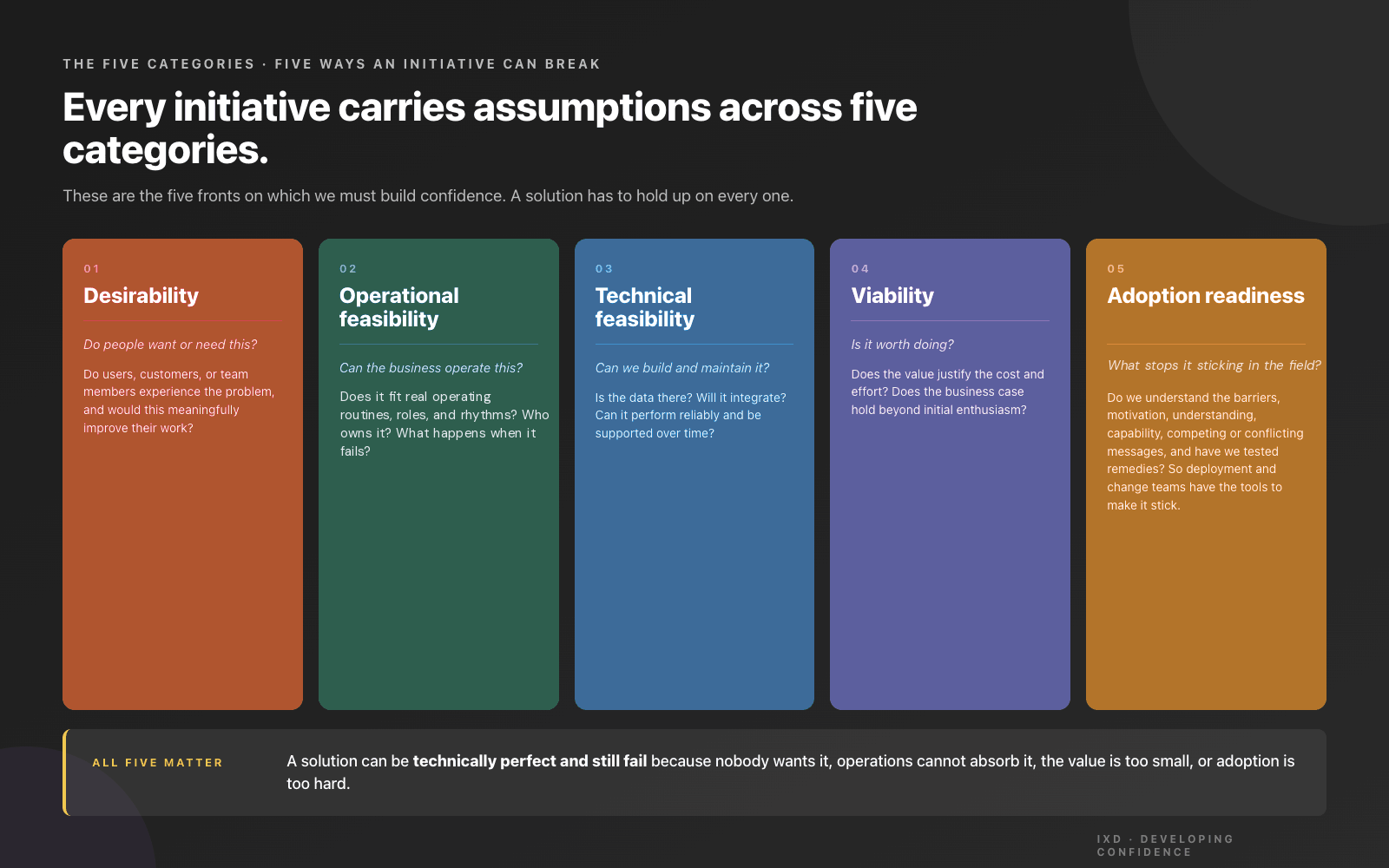
Desirability
Do users, customers, or team members have the problem, and would this improve their work enough to matter?
Operational feasibility
Does it fit real operating routines, roles, and rhythms? Who owns it, and what happens when it fails?
Technical feasibility
Is the data there, will it integrate, and can it run reliably and stay supported over time?
Viability
Does the value justify the cost and effort? Does the business case hold past the first wave of enthusiasm?
Adoption readiness
Will the change stick once the novelty wears off and the team moves to the next thing?
All five matter. A technically perfect solution still fails if nobody wants it, operations cannot absorb it, the value is too small, or adoption is too hard.
Prioritisation
You do not work the five in order.
You test the next thing most likely to break the initiative, wherever it sits. Two questions rank it:
- How critical is the assumption? If it is wrong, does the initiative break, or do you adjust and carry on?
- What is the current confidence? Still belief only, or already backed by evidence?
Test the assumption that is both critical and lowest on the evidence scale. First, whatever category it falls in.
How confidence works →The field guides
Three printable companions.
The source guides this site is built from. Download to read offline or print.
Master Guide
The complete model in one document: what the work is, the Solve, Build, Trial arc, the five categories, prioritisation, and the confidence levels.
Creating Assumptions
From a problem, opportunity, or pre-defined solution. Diagnose the current state, or risk-scan a solution before testing.
Developing Assumptions
From a proposed solution. Turn it into testable assumptions across the five dimensions, in nine steps.
The guide
Six sections.
The Model
What the work is, how the phases fit, the five categories, prioritisation, the confidence levels, and the decision rhythm.
Getting Started
The four starting points, and the practice each one calls for.
The Practice
Diagnosing a problem, risk-scanning a pre-defined solution, and writing testable assumptions across the five dimensions.
Confidence & Prioritisation
The evidence scale from Assumed to Confirmed at scale, and the 2×2 that surfaces the assumptions to test first.
Artefacts & Templates
The Bet Brief, the assumption registers, the Initiative Snapshot, the 6-week cycle brief, and the Open Studio readout.
Reference
Glossary, the distinctions teams blur, the twelve common mistakes, and the coaching checklist.